Wednesday, April 18, 2012

The Pyramids


Katie: You would never know it and can't tell form this picture, but the great Pyramids of Giza sit just outside of Cairo, on the western edge of town. In fact if the pollution is not too bad I can see them from the autostrad on my way home from work some days.


The Sphinx kissing Ruby on the head. The sphinx is a lion body with a pharaoh's head. His nose is worn off because of the wind.


Soooo cheesy!


Ruby and Paul in a carriage in front of the smallest pyramid at Giza which is called Menkaure.


Ruby and an Egyptian friend in front of the step pyramid in Saqqara.

A guy harvesting dates in Saqqara


Ruby riding a camel around the step pyramid at Dahshur


I think some people said they would pay money to see Paul on a camel - I'm expecting to cash in big on this. Peg???


Friday, March 23, 2012

RUBY AND PAUL DO LUXOR!


Ruby: You have to wake up early in the morning (4 am) to go on a balloon ride. The hot air balloon captain and other members of the crew put hot air (fire) in the balloon.  You get to see it and it is worth it. You can see how people have their animals on the roof. BRING A CAMERA!!!


Ruby: Omar is a very nice man who is a horse carriage driver in Luxor. Of course everyone knew Omar. Omar was a good man he has 1 brother. He has 2 horses that trade on and off every other day, so the horses can rest and eat. His carriage is number 73. 


They had a wedding in Luxor and this is a picture of the wedding carriage ride.


Ruby: We went in the mosque where an Iman showed us around. 


Ruby: The avenue of the Sphinxes is the road that leads to Luxor Temple. It is where important people would walk down to see and congratulate the arrival of a very important guy. In Luxor Temple Paul and I played hide and go seek.


This pillar is 6 arms around!


Ruby: You will have a guide on the horseback ride, he will ride a donkey though. The horses know the way. If you take a 1-hour ride you will ride a long the Nile River. You will see small cafes and feluccas. Don't forget your camera!!!


Saturday, February 25, 2012

Alexandria - 2


There is an edge to Alexandria; people speak a little less English, are just a little less friendly, at times maybe a little more desperate. The horse carriage driver man is angry when we won’t take him up on the offer of a ride, the women selling kleenex (a common item for sale on the street) grabs on to me and doesn’t let go until I take her hand from my jacket. We are a little more of an oddity here and see very few others that look like us.

Everyone said to have low expectations – that Alexandria is a place that conjres images of past glories but that now, now things are different and not so glorious. Not scholars of ancient things, we tend to look at the “now” of things which helped us have a good time and some cool experiences.


Ruby: Paul and Ruby stand on the balcony in Alexandria with the Mediterranean Sea behind us. What a great view from our hotel room!!!

Katie: We stayed at the Egypt Hotel which had a self operated old fashioned wrought-iron elevator from the  - who knows what era - which made us feel like movie stars. The other perk of the hotel was the handsome front desk man with dreamy eyes who looked and talked like Omar Sharif! Sorry no photo.


Lettuce delivery system in Egypt


Egyptians have a sweet tooth – do doubt about it! This is feteer, a flakey pastry dough with lots of oil and butter that might be filled with custard for dessert or cheese for a savory dinner. Problem is – you have to buy the entire thing – one reason for the extra poundage I am accumulating in Egypt.


Ruby: Me with the artist in the exhibition museum!!!!! We were looking at the exhibition hall because last year someone stole a Van Gogh painting so they closed every art museum.

Katie: As Ruby says they closed most all of the art museums in Egypt over a year ago after a Van Gogh was stolen from a museum in Cairo. In fact the same painting had been stolen twice, once before in the 1970’s and then was recovered some time later. Since the revolution we think the government probably beefed up security at antiquities museums because this is what tourists come to see, but closed those with modern art because they could not guarantee the safety of paintings, sculptures and other works of art. Sad for us – sad for artists working today.

But – at the Museum of Mahmoud Said – Egypt’s greatest 20th century artist they have 2 small exhibition halls that they said we could visit - only because we stood there and looked sad that we could not go inside the big old Italian villa museum that housed Mahmoud's work. It was fantastic! Three of the artists whose work we were admiring were there and talked to us about art, their art, art in Egypt, upcoming shows in Cairo. 


Me with the artist of a mosaic. One of the 7 wonders of the ancient world is the lighthouse in this picture. The lighthouse was destroyed in an earthquake long ago. Another wonder is the pyramids.


Katie: Libraries go back a long way in Alex – to the 3rd century BC. Apparently they are good places to plunder and destroy so they have come and gone over the centuries. The Bibliotheca Alexandrina opened in 2002 and has 8 million books, art galleries and concert halls and is the cultural call to fame for Alex these days. We hope it sticks around!

Ruby: The holes in the ceiling in the library are shaped like eyes and are blue and green to help you see better for reading. Isn’t that cool?? I still wonder why blue and green help the eyes read but I know it is true. 


A statue in the library art gallery


Ruby took this photo in the library art gallery - 


An outfit from the western desert area of Egypt near the oasis of Siwa - a place we hope to visit. There are so many things we saw in the museums here that we have never seen before. Guess Islamic/Muslim artifacts and art don't make it much to the US which is a shame - they are beautiful, sophisticated, unique.

Ruby's art work!!!


Fort Qaitbey

Katie: This castle-like place sits on one of the peninsulas that protects Alex’s harbor. There used to be a lighthouse on this site – as Ruby mentioned - it was one of the 7 wonders of the ancient world.


Ruby: On the ledge that we were on there was a wall, my mom, Paul and I saw that 3 guys were walking on the wall that guarded the building from too much water and when the last guy was getting up a large wave of water drenched him, then the other guys looked back walked faster, looked back and walked faster.


We ran into a group of high school students at the fort – on a school field trip we imagine. One offered to take our picture, the cell phones came out and the paparazzi broke lose! We were THE photo opportunity and English practicing point – what fun!


and

Saturday, February 11, 2012

The Zabbaleen


Ruby - The garbage people take your trash and recycle it to make paper, aprons, big plastic bowls, rugs and many other things. Their name is the Zabbaleen. Zabbaleen means “garbage collector” in Arabic. They reuse plastic, paper, metal, cloth, and many other things. They recycle 80% of the trash they collect – that is amazing!

The Zabbaleen use to be subsistence farmers in Upper Egypt before they moved to Cairo. Subsistence farmer means that they grow just enough food to feed themselves. Upper Egypt is actuality the southern part of Egypt and Lower Egypt is the northern part of Egypt.  Mostly they are Coptic Christians, a religious minority in Egypt, a country that is 90% Muslim. They live in Moqattum Village on the fringe of Cairo. 


In the 1970’s they built 3 churches in the caves in Moqattum, the surrounding mountain. The largest church holds up to 20,000 people and has carvings that show stories from the bible.  They also have some cool mosaics. 


Staircase from the churches to a view of garbage city. 


Ruby - they keep their animals on the roof tops. 
Katie - The Zabbaleen used pigs to eat the organic matter in the trash and then recycle the rest of it - a very efficient system.  In 2009, in response to the threat of swine flu – the government killed all the pigs making life even harder for the Zabbaleen. Not only did they lose the ability to get rid of organic waste, they lost the income that came from selling the pigs when grown. 


Everyone works in garbage city - even the children. They use these carts to transport the garbage from nearby homes to garbage city. 


They take the plastic and cut it into smaller pieces and recycle it.      


Ruby’s impressions:
  • -       Lots of garbage, as you would expect from a place called garbage city
  • -       Lots of people saying hello
  • -       Lots of people saying “hello, how are you and welcome to Egypt,” probably the only words they know in English.
  • -       This is one of the few places in Egypt where no one tries selling you anything
  • -       Some ladies wore very pretty dresses, but most wore tattered, dirty clothes.
Paul's impressions:
  • Kids grow up fast here.


Katie’s impressions:
  • Lots of smiling faces - like the rest of Egypt
  • Lots of kids wanting to shake hands with us and some wanted to touch Ruby
  •  We will never look at trash the same


Two buddies pleased to have their picture taken


Ruby looking 14


Ruby - They have an organization called Association for the Protection of the Environment  (APE). APE helps the garbage people,  especially the women and children. The APE has a shop where they sell extraordinary hand made paper made from trash. They also make rugs from recycled rags.


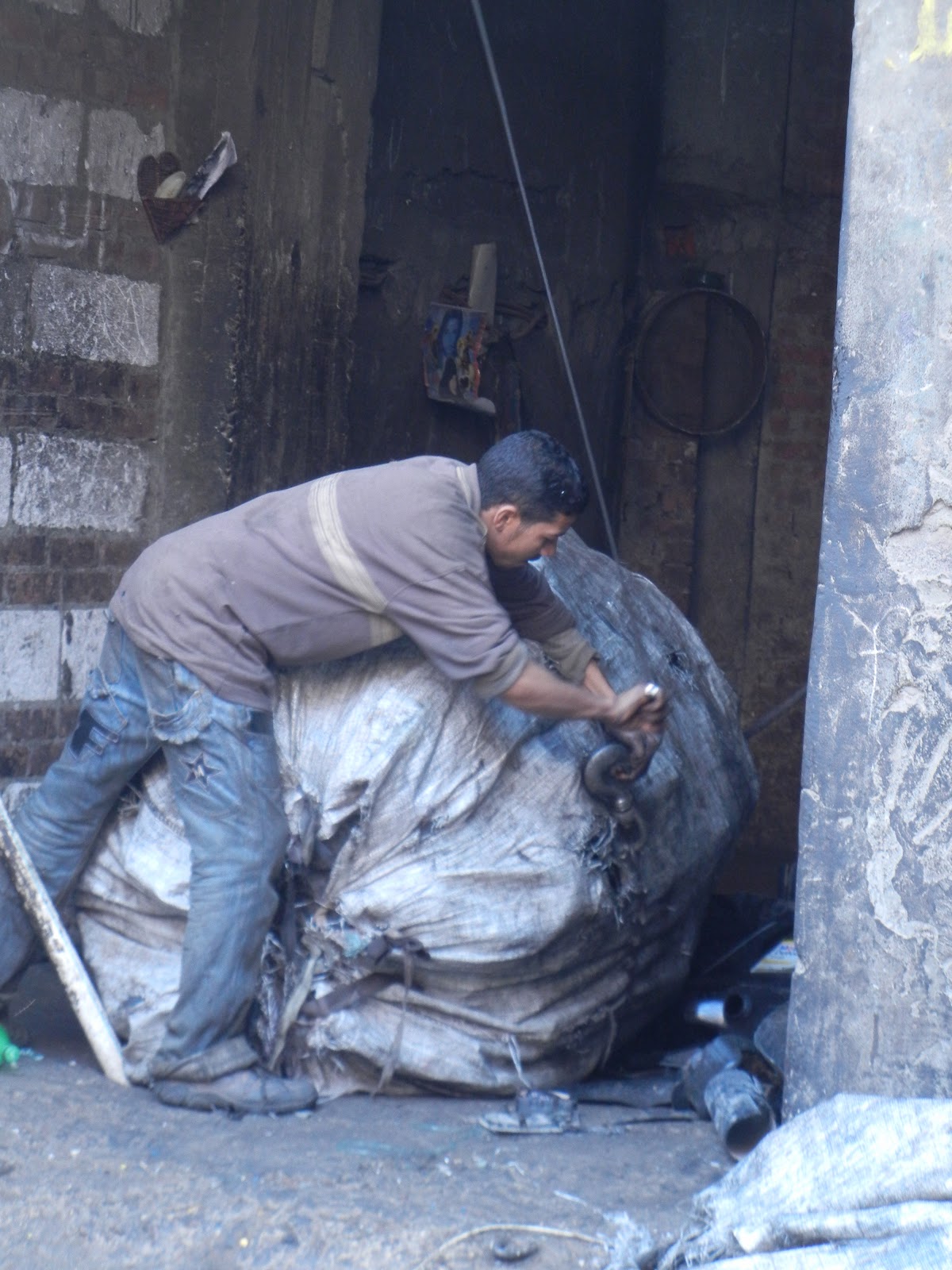
Giant bags of rubbish gathered front he streets of Cairo are brought here and sorted by women and children. They sort it all by hand - piece by piece.


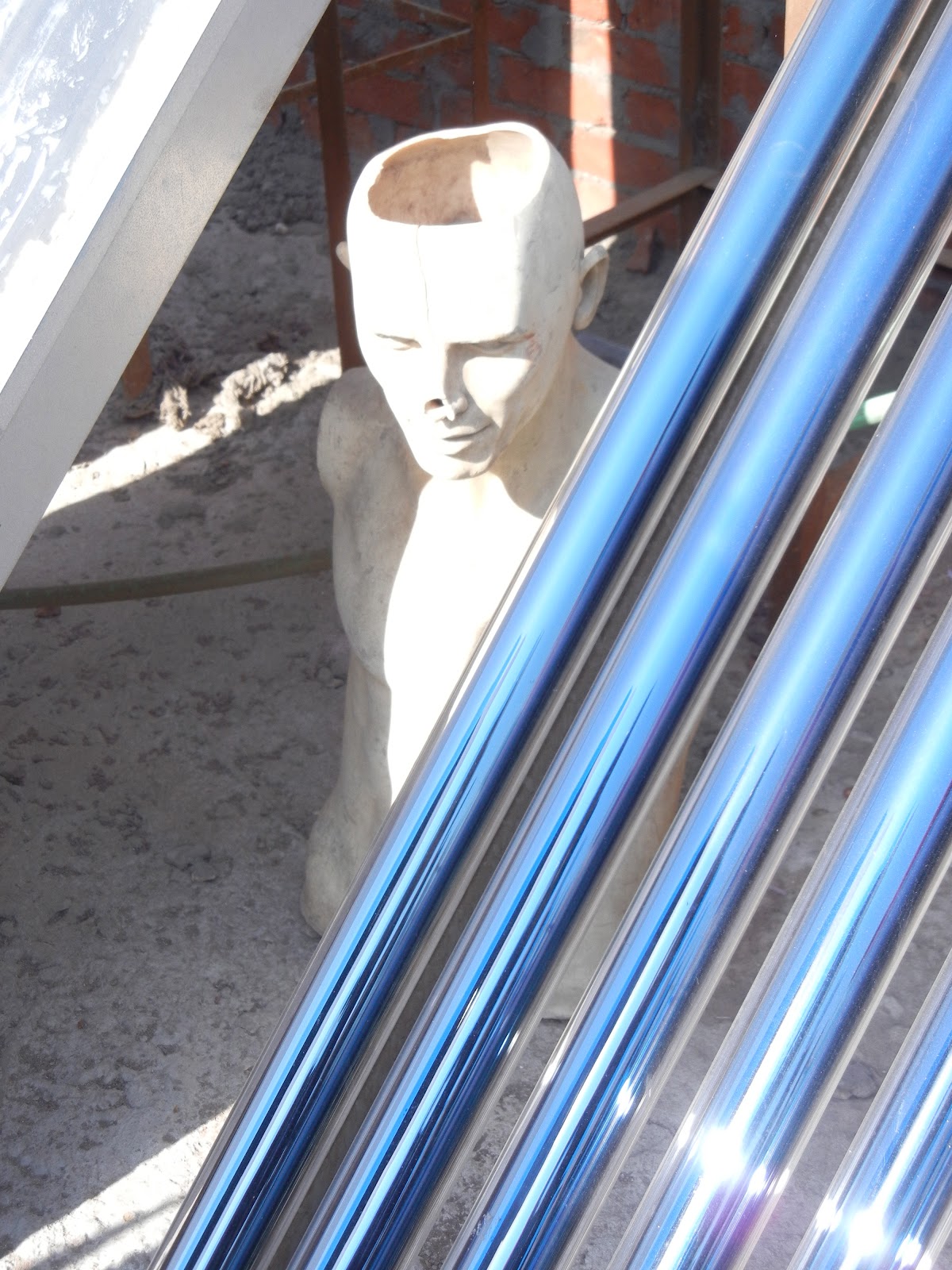
We went to a family’s house to have tea and see their solar panel made from recycled scraps of metal. The solar power panels made from recycled material cost 3,000 Egyptian pounds (LE) or about $500.00.  They also made a biogas machine to make methane fuel to make fire for cooking.  2kg waste = 2 hours of fire in the biogas machine. They hope their ideas spread to others in garbage city. 


The biogas machine


On the right the solar panel from China, on the left the one made from recycled materials in garbage city. 


The Zabbaleen suffer greatly from anemia, trachoma, and hepatitis C. A young woman we met is trying to help this problem through education. 


You can google Zabbaleen to learn more about them. And you can watch a movie called Garbage Dreams. The Zabbaleen are the face of garbage.